Sharing resources: a claims pattern for Compound Promises

If you have been writing Compound Promises, you have probably wondered: what happens when multiple resources need to share one unique resource provided by a sub-Promise?
For example, imagine an Application Promise that deploys applications on Kubernetes. Each application may need a namespace on the destination cluster, so you make it a Compound Promise and use the Namespace Promise from the Marketplace. You know the drill: the Application Promise's configure pipeline writes the Namespace request to /kratix/output/, Kratix schedules it to the Platform cluster, and the Namespace Promise does its thing.
You request your first application, app-one, in the team-mobile namespace. The pipelines run, you see the Namespace request come through, the namespace appears on the destination, shortly followed by the application. So far, so good. You now want to deploy a second application, app-two, also in team-mobile. You send the request, the pipeline runs, and... nothing happens.
You check your GitOps agent logs and see that you now have two requests for the same Namespace. It does not like that. You update your Promise pipeline to only emit the Namespace request if it does not exist yet. Everything seems to work, until you delete app-one, the original requester of the Namespace. As the Namespace request is owned by app-one, it gets deleted. app-two, deployed in that namespace, gets wiped out in the process. Absolute chaos.
Congratulations: you have discovered that work ownership and shared resources are not friends.
In this post we walk through a Promise design that fixes this. We call it claims, and there is a working example in the Marketplace.
The problems
Here is what is going on under the hood.
When a workflow writes a document to /kratix/output/, that document becomes part of a Work object owned by that specific resource request. If you are not familiar with Works, we wrote about them in How your Resources get from Promise to Destination. When the parent request goes away, its Work is garbage-collected, and the documents in it go with it.
That explains the wipeout when you deleted app-one: the namespace request was work-owned, so it left with the first Application even though app-two was still running.
The GitOps failure is the other side of the same coin. Multiple Applications each emitting their own copy of the same namespace request means multiple Works declaring the same resource ID in the State Store. Your reconciliation path falls over with duplicates, even when the Platform cluster looks fine.
What is a claim?
The fix is to separate saying you need something from actually creating it.
Your Application Promise should not create the namespace directly. Instead, it places a reservation with an intermediate Promise: "I need team-mobile." Not the namespace itself, just a record that this Application is counting on it.
That intermediate Promise owns the shared resource lifecycle: it creates the namespace when the first reservation arrives, ignores subsequent ones, and tears it down only when no reservations remain. This mechanism is what we call a claim. A NamespaceClaim is not the namespace; it is a lightweight, per-consumer signal that someone is still using it.

The same shape generalises beyond namespaces: a DB server and many DB instances, a Kafka cluster and many topics. The counting idea stays the same; only what gets created and destroyed changes.
You can watch a walkthrough of the claims pattern in action in the video below:
How it works in practice
Let's replay the app-one / app-two scenario from the intro using NamespaceClaim Promise.
The fundamental difference is that the Application Promise no longer writes to /kratix/output the Namespace request directly, but rather a NamespaceClaim request like the one below. It does not need any extra logic; it behaves like any other Compound Promise:
apiVersion: marketplace.kratix.io/v1alpha1
kind: NamespaceClaim
metadata:
  name: my-app-namespace-claim
  namespace: default
spec:
  namespaceName: team-mobile
The first Application claims a namespace

When app-one is requested, defining team-mobile as its target namespace, Kratix will run the Application promise resource configure workflow. The workflow will output the claim (1), which in turn will execute the NamespaceClaim resource configure workflow. No provider Namespace request exists for team-mobile yet, so one is created imperatively outside /kratix/output/, so it escapes work ownership (2). The Namespace Promise schedules the real Namespace to the worker (3).
A second Application joins the same namespace
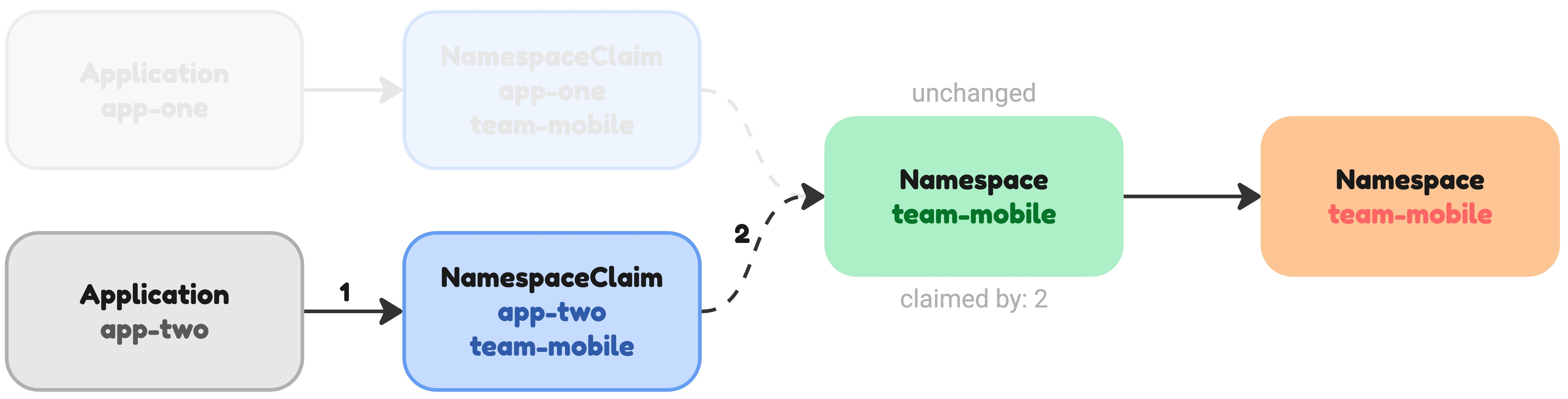
You now want to deploy app-two into the same team-mobile namespace. When the request comes in, the Application Promise does the same thing it did for app-one: it emits another NamespaceClaim to /kratix/output/ (1), and Kratix runs the claim Promise's configure workflow again.
This time, the provider Namespace request is already on the Platform cluster (2), so there is nothing new to create. You end up with two live claims pointing at the same namespace, and still exactly one namespace on the destination.
Deleting an Application (and its claim)
When you delete app-one, its NamespaceClaim goes with it, as Kratix will delete any Work belonging to the Application. That triggers the claim Promise's delete workflow, which counts how many live claims for team-mobile still exist. app-two is still around, so the count stays above zero: the provider request stays, the namespace on the worker stays, and app-two keeps its home.
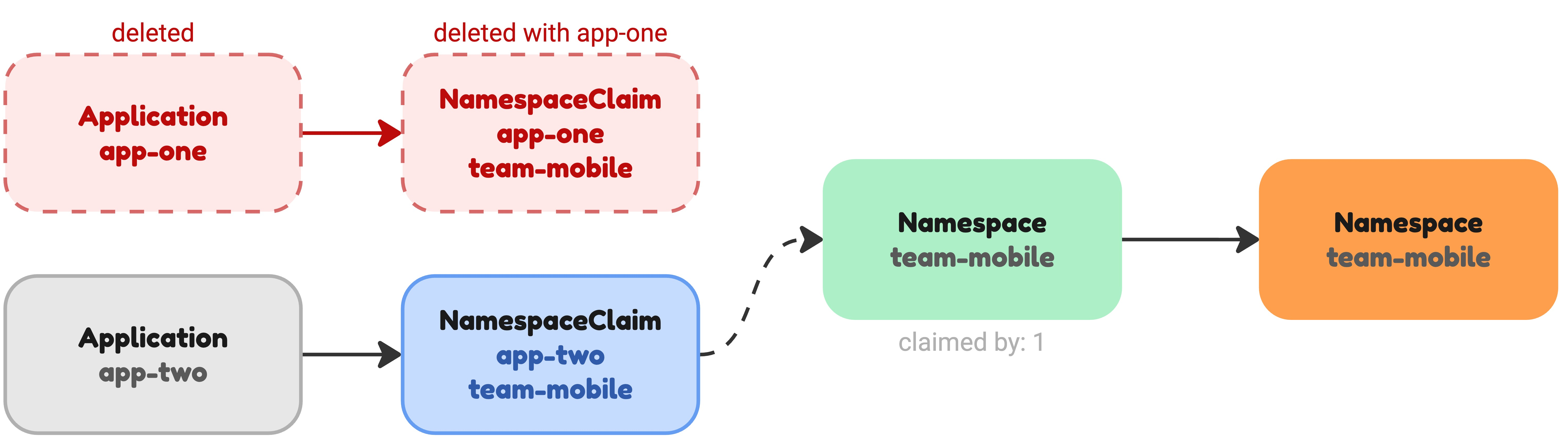
This is the scenario the naive Compound Promise pattern gets wrong. With the claims model, the first Application is no longer the owner of the namespace.
When app-two is deleted, the story now ends cleanly. Its claim disappears, the delete workflow runs the count again, and this time nobody is left reserved on team-mobile. The provider Namespace request is removed, the Namespace Promise's Work is garbage-collected, and the namespace is pruned from the worker.

Deleting the actual resource when there are no claims left is a design choice. You may decide to keep the resource around for future claims, or you may want to clean it up to save resources. The NamespaceClaim Promise in the Marketplace implements the delete workflow, but you can implement your own claim Promise that does not delete the resource when there are no claims left: just skip adding a delete workflow to your Promise.
Try it
If you want to poke at it yourself, try out the NamespaceClaim promise available in the marketplace. Install the Promise, apply the examples below, and observe what the promise produces. Then delete them in order and watch what happens to the namespace on the worker:
kubectl apply -f https://raw.githubusercontent.com/syntasso/kratix-marketplace/main/namespace/promise.yaml
kubectl apply -f https://raw.githubusercontent.com/syntasso/kratix-marketplace/main/namespace-claim/promise.yaml

kubectl apply -f - <<EOF
apiVersion: marketplace.kratix.io/v1alpha1
kind: NamespaceClaim
metadata:
  name: team-a-claim
  namespace: default
spec:
  namespaceName: shared-team-namespace
EOF

kubectl apply -f - <<EOF
apiVersion: marketplace.kratix.io/v1alpha1
kind: NamespaceClaim
metadata:
  name: team-b-claim
  namespace: default
spec:
  namespaceName: shared-team-namespace
EOF

kubectl delete namespaceclaim team-a-claim   # namespace stays
kubectl delete namespaceclaim team-b-claim   # last claim gone; namespace removed
Beyond namespaces
Namespaces are the straightforward case: the shared resource is defined almost entirely by its name. Every consumer wants the same exact resource (i.e. a namespace called team-mobile) and the only question is whether anyone still needs it.
Shared databases, Kafka clusters, and load balancers are harder. Consumers often want the same shared resource but not the same configuration. One application may need a schema and a read-write role; another may need different credentials on the same Postgres server. Worse, two applications might request the same database name with incompatible engine versions or storage tiers. Who should own the config?
The Claim Promise is still the right place to answer that, but its job splits into layers:
- Shared identity: what resource are we counting? (
team-mobile-db,orders-topic) - Provisioning config: how is the shared resource created? (engine, version, size, HA)
- Consumer config: what does this particular application need on top? (schema, user, grants)
The Claim Promise decides whether that shared resource already exists and owns its lifecycle. It should not try to own every per-application variation unless those variations are part of the shared contract. When consumers need different things on top of the same shared resource, a two-tier model often works better: one claim for the shared server, and a separate per-consumer claim for the part each application needs:
# Shared database, like the NamespaceClaim
apiVersion: marketplace.kratix.io/v1alpha1
kind: DatabaseClaim
metadata:
  name: my-db-claim
  namespace: team-mobile
spec:
  databaseName: team-mobile-db
  requirements:
    engine: postgres
    tier: standard

# Per-application part, owned by the consumer
apiVersion: marketplace.kratix.io/v1alpha1
kind: SchemaClaim
metadata:
  name: my-db-schema
  namespace: team-mobile
spec:
  databaseRef: team-mobile-db
  schemaName: orders
The namespace example works because there is nothing to disagree on. Once configuration varies, your Claim Promise is the contract: it defines what is shared, what is per-consumer, and what to do when two requests clash. Design those rules into the schema and workflows early: reject incompatible claims, merge requirements, or let the first claimant set the baseline.
Wrapping up
Claims give you shared sub-promise resources without fighting work ownership. The parent emits a lightweight reservation; the claim Promise handles create-once, delete-when-empty. The namespace-claim Promise in the Marketplace is the reference implementation, but the pattern is what you reuse when the next shared resource shows up on your roadmap.
We would love to hear how you use it, or what breaks when you try. Drop by Slack or GitHub.
